When Normal Isn’t Natural
I used to work in a riding stable. I loved it. There was something about the daily routine the way it made life feel, safe and structured and predictable, and if life was structured for us stable workers it was a hundred times more ‘structured’ for the horses’ and therefore by logical extension I supposed life must have been a hundred times better for the horses. No danger, daily food, shelter, warmth. It was all rather comforting.
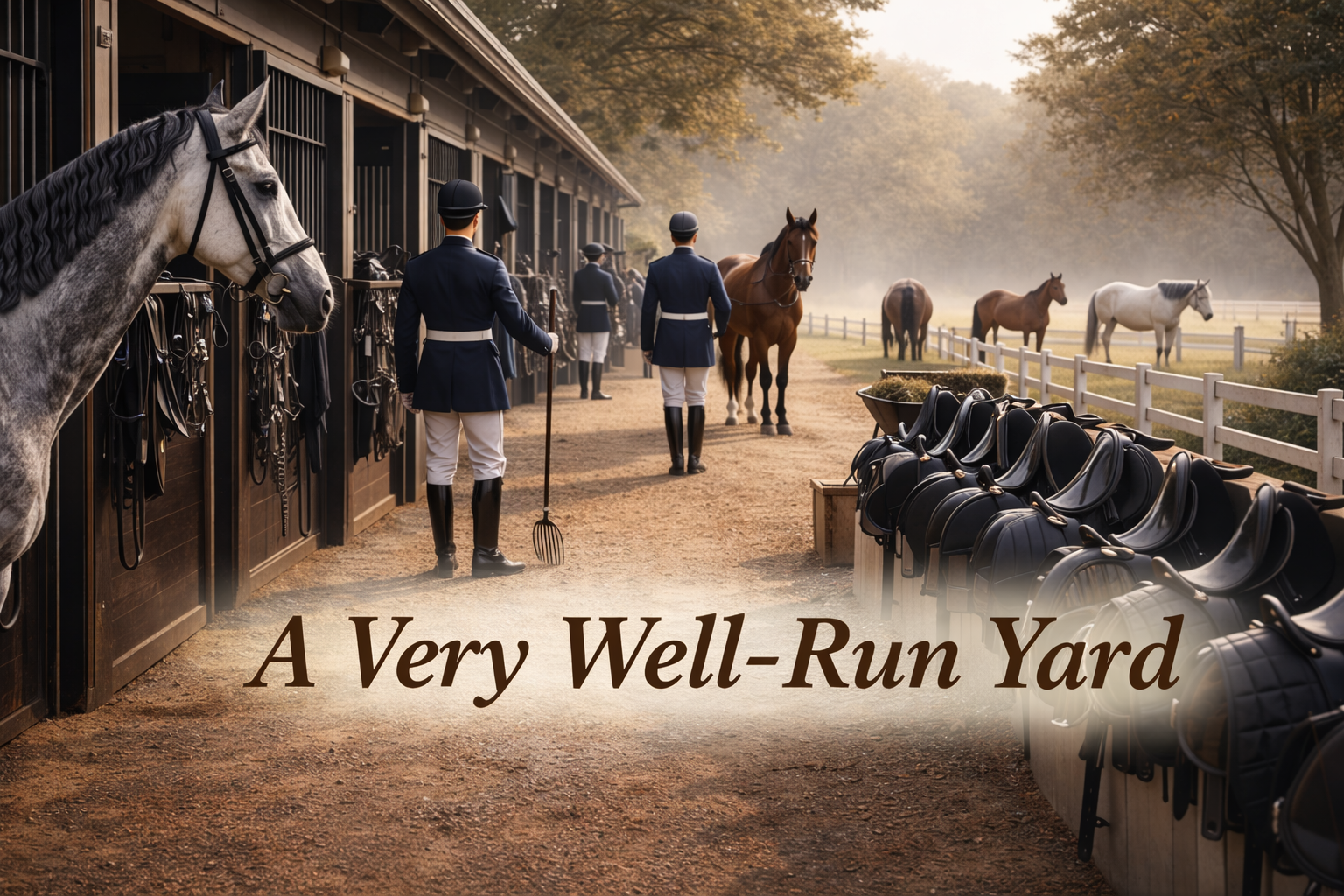
I used to love the cold mornings, the long rows of boxes and bars, wood and metal. There were always a few horses sticking their heads out. Steaming breath rising in the air. It was amazing how they seemed to always know when it was getting near feeding time.
‘Horses must have an incredible internal clock’ I thought. I later learned this wasn’t their internal clock at all, but conditioning — the rattle of buckets predicting food.
I had just started to study animal behaviour back then so I knew that this was really something called ‘classical conditioning’ where one thing predicts another. (I explain this in greater detail in my book ‘Revealing your Hidden Horse’).
The prediction in this case was a combination of the rattle of buckets, the smell of the food and the time of day. It was also the time when some horses misbehaved.
There were horses that were ‘door knockers’ they would kick the doors of their stables rhythmically, (eventually demolishing the door!). Others were ‘foot scrapers’, they would impatiently scrape their left or right foot along the ground (like us, horses can be left or right ‘handed’) even to the point of wearing away the stones and concrete of the yard, Although of course, to us the real annoyance was the fact that they routinely wore away their horseshoes. This carried on until they were fed.
The ‘yard’ was run along military lines and this was not surprising as the owners were old-school ex-army types. There was always a right way and a wrong way of doing things, a special way for example, to stack the ever growing daily manure pile (rectangularly if you’re interested).
So that was it, – routine military efficiency, and above all we loved our horses. There is no question about that.
The work was hard and physical, nobody did it ‘for the money’. It was all-weathers, rain, snow or sunshine. You were constantly dirty, smelly, wet, freezing or sweating but we worked for love of the animals, because we were nice people.
And yet something was not quite right.
Our horses were shut in all day, usually tied up and waiting for a customer to come and take their first ride. Some customers came for riding lessons, each was given a riding crop, they would be given a horse to ride that we assessed was suited to them and their level of experience. They would trail off toward the school and then spend the next hour riding round in geometric patterns. They were never encouraged to use their whip unless their horse was being lazy. And let me tell you we had some lazy horses.
Sometimes a horse would be very naughty and go ‘mad’, bucking and cantering and throwing their rider off. Then the head girl who was an experienced rider would ride the horse around the school many times using her riding crop, to reinforce the horse’s training. It was cause and effect, this was what you did to horses who would not obey. In this way it was hoped that the horse would learn a lesson.
Obey me or suffer the consequences.
They say when you know, you know.
I couldn’t help noticing that we wanted horses that would be predictable in their behaviour and only make a minimal effort,
… but we also wanted horses that would be responsive and NOT just make a minimal effort.
If they only made a minimal effort a riding crop could be used to ‘wake them up’. If they woke up too much a riding crop would be used to calm them down, (punish them for going too fast). I have seen people striking horses with a whip to make them stand still.
Naturally this led to some very confused horses and equally confused riders. It was the confused horses that had the outbursts and threw their riders. I noticed it also seemed to be the most intelligent horses that were prone to this behaviour.
If these outbursts happened too often then the horse would be deselected for lessons and was categorised as dangerous and no longer fit for purpose, this meant it would be sold and a quiet replacement found.
Then they sold my favourite horse.
It was quite a shock. He was my best equine friend and probably the most intelligent horse in the yard.
I could not afford to buy him on my less than minimal wage (we worked for love, remember)
But you can’t buy horses with love.
This is when I really began to question things and the more I learned of the science of behaviour of both horses and humans the more I started to wake up and ask questions. The more I saw that these horses that I knew and loved, were living lives that were completely unnatural and fundamentally against their nature as animals and so… I decided that I needed to own my own horses. – but that’s another story.
It was also a time when I began to reject what was considered ‘normal’.
Because ‘normal’, I realised, is not always natural.